<?xml version="1.0" encoding="utf-8"?>
<feed xmlns="http://www.w3.org/2005/Atom">
    <title>logicalhacking.com: Posts tagged staff&positions</title>
    <link href="https://logicalhacking.com/blog/tags/staff%26positions/index.xml" rel="self" />
    <link href="https://logicalhacking.com" />
    <id>https://logicalhacking.com/blog/tags/staff%26positions/index.xml</id>
    <author>
        <name>Achim D. Brucker</name>
        <email>adbrucker@0x5f.org</email>
    </author>
    <updated>2026-03-09T00:00:00Z</updated>
    <entry>
    <title>PhD Position in Formalizing Number Systems</title>
    <link href="https://logicalhacking.com//blog/2026/03/09/phd-position-in-formalizing-number-systems/" />
    <id>https://logicalhacking.com//blog/2026/03/09/phd-position-in-formalizing-number-systems/</id>
    <published>2026-03-09T00:00:00Z</published>
    <updated>2026-03-09T00:00:00Z</updated>
    <summary type="html"><![CDATA[<article>
  <header>
    <div class="meta">
      Posted on 
      <time datetime="2026-03-09" pubdate data-updated="true"> 9 March 2026</time>
       by  <a href="https://www.brucker.ch/">Achim D. Brucker</a>, 
      licensed under <a href="https://creativecommons.org/licenses/by-nd/4.0/">CC BY-ND 4.0</a>.
      <div class="tags"><a href="/blog/tags/uoe/index.html">uoe</a> | <a href="/blog/tags/staff%26positions/index.html">staff&amp;positions</a> | <a href="/blog/tags/verification/index.html">verification</a> | <a href="/blog/tags/formalmethods/index.html">formalmethods</a></div>
      <meta name="fediverse:creator" content="@adbrucker@fediscience.org">
    </div>
    <h1 class="entry-title">
      <a href="/blog/2026/03/09/phd-position-in-formalizing-number-systems/">PhD Position in Formalizing Number Systems</a>
    </h1>
  </header>
  <p>We have an open PhD position in <em>Bridging the Gap Between Mathematical Numbers and Software Systems</em>. To fill this position, we are seeking an enthusiastic PhD candidate with a strong background in computer science, software engineering, mathematics, or closely related fields. Expertise in formal methods such as program reasoning, programming language semantics, model checking, theorem proving, or computational logic is essential.</p>
<!-- MORE -->
<p>Mathematical models, e.g., describing physical systems or cryptographic algorithms, rely on ideal numbers. For instance, mathematical integers are infinite and mathematical reals continuous and infinite. Computers work with finite approximations that are bounded (i.e., there is a smallest and largest number) and discrete. This “digital gap” between mathematical models and actual systems is a challenge when implementing safety-critical or security-critical systems: for example, autonomous aircraft or self-driving cars require high-precision representations of their position to avoid collisions. Hence, not considering the approximation of the approximative representation of numbers in computers can result in crashes that can endanger the life of humans. Moreover, many security-critical systems, not limited to cryptographic algorithms, rely on the correct handling of over- and underflows in integer computations. Actually, underflow- and overflow bugs are a root cause for a large number vulnerabilities exploited by cyber security criminal, e.g., for stealing digital currencies worth several billion of dollars. While this is not a new problem (e.g., already in 1982, an float conversion error in a trading systems at the Vancouver Stock Exchange resulted in a loss of several millions of US dollars), an integrated development method preventing such bugs is still not available.</p>
<p>This PhD project will address this challenge by developing a rigour approach for developing systems relying on precise representations of numbers, using the interactive theorem prover Isabelle/HOL. The PhD project can focus on</p>
<ol type="1">
<li>the formalisation of concrete representations of machine numbers (e.g., IEEE754, POSIT, Decimal Floating Point, Fixed Point Arithmetic), their (algebraic) properties, and relationship to abstract mathematical numbers;</li>
<li>the formalisation and verification of numerical or cryptographic algorithms, establishing a reusable verified library, or</li>
<li>the development of an end-to-end refinement approach from mathematical models to machine representations.</li>
</ol>
<p>The PhD will be jointly supervised by Prof. Dr. Achim Brucker and Prof. Dr. Burkhart Wolff, leading to a joint degree from the University of Exeter and the University of Paris-Saclay.</p>
<p>Information about the programme can be found at</p>
<ul>
<li><a href="https://www.exeter.ac.uk/study/pg-research/funding/phdfunding/paris-saclay/" class="uri">https://www.exeter.ac.uk/study/pg-research/funding/phdfunding/paris-saclay/</a></li>
<li><a href="https://adum.fr/as/ed/voirproposition.pl?langue=en&amp;matricule_prop=71068&amp;site=PSaclay" class="uri">https://adum.fr/as/ed/voirproposition.pl?langue=en&amp;matricule_prop=71068&amp;site=PSaclay</a></li>
</ul>
<p>All applications have to be made via the ADUM system:
<a href="https://adum.fr/as/ed/voirproposition.pl?langue=en&amp;matricule_prop=71068&amp;site=PSaclay" class="uri">https://adum.fr/as/ed/voirproposition.pl?langue=en&amp;matricule_prop=71068&amp;site=PSaclay</a>,
latest on the 22nd of March 2026.</p>
</article>
]]></summary>
</entry>
<entry>
    <title>PhD Position in Verification of Golang</title>
    <link href="https://logicalhacking.com//blog/2025/01/25/phd-go-verification/" />
    <id>https://logicalhacking.com//blog/2025/01/25/phd-go-verification/</id>
    <published>2025-01-25T00:00:00Z</published>
    <updated>2025-01-25T00:00:00Z</updated>
    <summary type="html"><![CDATA[<article>
  <header>
    <div class="meta">
      Posted on 
      <time datetime="2025-01-25" pubdate data-updated="true">25 January 2025</time>
       by  <a href="https://www.brucker.ch/">Achim D. Brucker</a>, 
      licensed under <a href="https://creativecommons.org/licenses/by-nd/4.0/">CC BY-ND 4.0</a>.
      <div class="tags"><a href="/blog/tags/uoe/index.html">uoe</a> | <a href="/blog/tags/staff%26positions/index.html">staff&amp;positions</a> | <a href="/blog/tags/test%26proof/index.html">test&amp;proof</a> | <a href="/blog/tags/formalmethods/index.html">formalmethods</a> | <a href="/blog/tags/programminglanguages/index.html">programminglanguages</a></div>
      <meta name="fediverse:creator" content="@adbrucker@fediscience.org">
    </div>
    <h1 class="entry-title">
      <a href="/blog/2025/01/25/phd-go-verification/">PhD Position in Verification of Golang</a>
    </h1>
  </header>
  <p>We have an exciting funded opportunity for a PhD on developing “Verification Environment for Distributed Systems Implemented in Go”. The main objectives are to define a formal semantics of Go and its CSP-inspired concurrency model in an interactive theorem prover (e.g., Isabelle/HOL) as well as developing a calculus for program verification. This is a unique opportunity to work in the intersection of theory and application and while doing so, contributing to improving the state of the art in software correctness and security.</p>
<!-- MORE -->
<p>A detailed description of the PhD proposal is available at:</p>
<ul>
<li><a href="https://www.exeter.ac.uk/v8media/recruitmentsites/documents/A_Verification_Environment_for_Distributed_Systems_Implemented_in_Go_EPSRC_DLA_Project_September_2025_Entry.pdf">A Verification Environment for Distributed Systems Implemented in Go</a></li>
</ul>
<p>Information about the funding and application process is available at:</p>
<ul>
<li><a href="https://www.exeter.ac.uk/study/funding/award/?id=5477" class="uri">https://www.exeter.ac.uk/study/funding/award/?id=5477</a></li>
</ul>
<p>Application deadline is the midnight GMT on 10th of February 2025.</p>
<p>Please reach out to me, if you have any questions.</p>
</article>
]]></summary>
</entry>
<entry>
    <title>Welcome, Bethaina!</title>
    <link href="https://logicalhacking.com//blog/2024/10/14/welcome-bethaina/" />
    <id>https://logicalhacking.com//blog/2024/10/14/welcome-bethaina/</id>
    <published>2024-10-14T00:00:00Z</published>
    <updated>2024-10-14T00:00:00Z</updated>
    <summary type="html"><![CDATA[<article>
  <header>
    <div class="meta">
      Posted on 
      <time datetime="2024-10-14" pubdate data-updated="true">14 October 2024</time>
       by  <a href="https://www.brucker.ch/">Achim D. Brucker</a>, 
      licensed under <a href="https://creativecommons.org/licenses/by-nd/4.0/">CC BY-ND 4.0</a>.
      <div class="tags"><a href="/blog/tags/uoe/index.html">uoe</a> | <a href="/blog/tags/staff%26positions/index.html">staff&amp;positions</a></div>
      <meta name="fediverse:creator" content="@adbrucker@fediscience.org">
    </div>
    <h1 class="entry-title">
      <a href="/blog/2024/10/14/welcome-bethaina/">Welcome, Bethaina!</a>
    </h1>
  </header>
  <p>I am happy to announce that Dr. Bethaina Touijer will join the
Software Assurance &amp; Security Research Team as a Postdoctoral Researcher.</p>
<!-- MORE -->
<p>Bethaina will work on developing formal methods for analysing business process logic, in
particular in the context of enterprise sytems.</p>
</article>
]]></summary>
</entry>
<entry>
    <title>PostDoc in Formal Methods for Business Process Logic</title>
    <link href="https://logicalhacking.com//blog/2024/03/20/postdoc-bpl/" />
    <id>https://logicalhacking.com//blog/2024/03/20/postdoc-bpl/</id>
    <published>2024-03-20T00:00:00Z</published>
    <updated>2024-03-20T00:00:00Z</updated>
    <summary type="html"><![CDATA[<article>
  <header>
    <div class="meta">
      Posted on 
      <time datetime="2024-03-20" pubdate data-updated="true">20 March 2024</time>
       by  <a href="https://www.brucker.ch/">Achim D. Brucker</a>, 
      licensed under <a href="https://creativecommons.org/licenses/by-nd/4.0/">CC BY-ND 4.0</a>.
      <div class="tags"><a href="/blog/tags/uoe/index.html">uoe</a> | <a href="/blog/tags/staff%26positions/index.html">staff&amp;positions</a> | <a href="/blog/tags/test%26proof/index.html">test&amp;proof</a> | <a href="/blog/tags/security/index.html">security</a> | <a href="/blog/tags/formalmethods/index.html">formalmethods</a></div>
      <meta name="fediverse:creator" content="@adbrucker@fediscience.org">
    </div>
    <h1 class="entry-title">
      <a href="/blog/2024/03/20/postdoc-bpl/">PostDoc in Formal Methods for Business Process Logic</a>
    </h1>
  </header>
  <p>As part of a US funded project, we have an exciting opportunity for a PostDoc in
the Security and Trust of Advanced Systems Group at the University of Exeter
(UK) to work applying formal methods to enterprise systems:</p>
<!-- MORE -->
<p>We will use formal methods (e.g., model checking, SMT solving, interactive
theorem proving), to analyze business-process-driven (enterprise) systems (e.g.,
business logic and workflows described a BPMN models). A particular focus will
be the analysis of complex compositions of workflows within one organization as
well as across multiple organizations.</p>
<p>In particular, we will develop novel techniques to detect faults and
vulnerabilities (that can be exploited by both internal and external attackers)
in complex business-process-driven systems, contributing to protecting critical
workflows such as manufacturing or logistics.</p>
<p>In such environments, attackers can exploit such faults and vulnerabilities to
cause all kinds of harm such as direct financial losses or causing the
production of safety or security critical products to stop. Overall, the project
aims to develop automated techniques for assessing the risk of business process
or workflows as well as finding and mitigating such attacks.</p>
<p>This is a unique opportunity for somebody wanting to use/apply formal methods to
the security of large enterprise systems.</p>
<p>More information and application details can be found at:</p>
<ul>
<li><a href="https://jobs.exeter.ac.uk/hrpr_webrecruitment/wrd/run/etrec179gf.open?WVID=171839ediw&amp;LANG=USA&amp;VACANCY_ID=386422ijTy" class="uri">https://jobs.exeter.ac.uk/hrpr_webrecruitment/wrd/run/etrec179gf.open?WVID=171839ediw&amp;LANG=USA&amp;VACANCY_ID=386422ijTy</a></li>
</ul>
<p>Application deadline is the 18th of April 2024. Please contact me for more details.</p>
</article>
]]></summary>
</entry>
<entry>
    <title>PhD Position in Verification of Golang</title>
    <link href="https://logicalhacking.com//blog/2024/03/01/phd-go-verification/" />
    <id>https://logicalhacking.com//blog/2024/03/01/phd-go-verification/</id>
    <published>2024-03-01T00:00:00Z</published>
    <updated>2024-03-01T00:00:00Z</updated>
    <summary type="html"><![CDATA[<article>
  <header>
    <div class="meta">
      Posted on 
      <time datetime="2024-03-01" pubdate data-updated="true"> 1 March 2024</time>
       by  <a href="https://www.brucker.ch/">Achim D. Brucker</a>, 
      licensed under <a href="https://creativecommons.org/licenses/by-nd/4.0/">CC BY-ND 4.0</a>.
      <div class="tags"><a href="/blog/tags/uoe/index.html">uoe</a> | <a href="/blog/tags/staff%26positions/index.html">staff&amp;positions</a> | <a href="/blog/tags/formalmethods/index.html">formalmethods</a> | <a href="/blog/tags/programminglanguages/index.html">programminglanguages</a></div>
      <meta name="fediverse:creator" content="@adbrucker@fediscience.org">
    </div>
    <h1 class="entry-title">
      <a href="/blog/2024/03/01/phd-go-verification/">PhD Position in Verification of Golang</a>
    </h1>
  </header>
  <p>We have an exciting opportunity for PhD study with myself and
Prof. Burkhart Wolff from the Université Paris-Saclay on developing
a formal semantics for Go(lang) in Isabelle/HOL.</p>
<!-- MORE -->
<p>This is part of a new ‘double PhD’ programme leading to a PhD award
from the University of Exeter and the Université Paris-Saclay.</p>
<p>More information and application details can be found at:</p>
<ul>
<li>https://www.exeter.ac.uk/study/pg-research/funding/phdfunding/paris-saclay/</li>
<li>https://adum.fr/as/ed/voirproposition.pl?site=adumR&amp;matricule_prop=53822#version</li>
</ul>
<p>Application deadline is the 31st of March 2024. Please contact us for more details.</p>
</article>
]]></summary>
</entry>
<entry>
    <title>Welcome, Teddy!</title>
    <link href="https://logicalhacking.com//blog/2023/09/23/welcome-teddy/" />
    <id>https://logicalhacking.com//blog/2023/09/23/welcome-teddy/</id>
    <published>2023-09-23T00:00:00Z</published>
    <updated>2023-09-23T00:00:00Z</updated>
    <summary type="html"><![CDATA[<article>
  <header>
    <div class="meta">
      Posted on 
      <time datetime="2023-09-23" pubdate data-updated="true">23 September 2023</time>
       by  <a href="https://www.brucker.ch/">Achim D. Brucker</a>, 
      licensed under <a href="https://creativecommons.org/licenses/by-nd/4.0/">CC BY-ND 4.0</a>.
      <div class="tags"><a href="/blog/tags/uoe/index.html">uoe</a> | <a href="/blog/tags/staff%26positions/index.html">staff&amp;positions</a> | <a href="/blog/tags/phdlife/index.html">phdlife</a></div>
      <meta name="fediverse:creator" content="@adbrucker@fediscience.org">
    </div>
    <h1 class="entry-title">
      <a href="/blog/2023/09/23/welcome-teddy/">Welcome, Teddy!</a>
    </h1>
  </header>
  <p>I am happy to announce that <a href="https://emps.exeter.ac.uk/computer-science/staff/tc599">Teddy Cameron-Burke</a> will join the
Software Assurance &amp; Security Research Team as a PhD student.</p>
<!-- MORE -->
<p>Teddy got his BSc in Computer Science and Mathematics from the University of Exeter. In his BSc
project, he formalized homomorphic encryption in Isabelle/HOL. Teddy will continue to work
with Isabelle in his PhD project, focusing on developing novel verification approaches
for domain-specific programming languages, e.g., for the development of cyber-physical
systems.</p>
</article>
]]></summary>
</entry>
<entry>
    <title>Thoughts on PGT and PGR Programmes</title>
    <link href="https://logicalhacking.com//blog/2022/11/25/pgt-vs-pgr/" />
    <id>https://logicalhacking.com//blog/2022/11/25/pgt-vs-pgr/</id>
    <published>2022-11-25T00:00:00Z</published>
    <updated>2022-11-25T00:00:00Z</updated>
    <summary type="html"><![CDATA[<article>
  <header>
    <div class="meta">
      Posted on 
      <time datetime="2022-11-25" pubdate data-updated="true">25 November 2022</time>
       by  <a href="https://www.brucker.ch/">Achim D. Brucker</a>, 
      licensed under <a href="https://creativecommons.org/licenses/by-nd/4.0/">CC BY-ND 4.0</a>.
      <div class="tags"><a href="/blog/tags/uoe/index.html">uoe</a> | <a href="/blog/tags/phd/index.html">phd</a> | <a href="/blog/tags/staff%26positions/index.html">staff&amp;positions</a> | <a href="/blog/tags/msc/index.html">msc</a></div>
      <meta name="fediverse:creator" content="@adbrucker@fediscience.org">
    </div>
    <h1 class="entry-title">
      <a href="/blog/2022/11/25/pgt-vs-pgr/">Thoughts on PGT and PGR Programmes</a>
    </h1>
  </header>
  <p>Universities in the UK (and the discussion in this post is based, and most
likely limited to, the UK academic sector) accept students with a UG (BSc)
degree into their PhD programs. Thus, students in the UK often wonder about the
differences between doing a postgraduate taught degree and a postgraduate
research degree. But also if you have already your MSc finished (or are close to
finishing it) and are considering applying for a PhD programme, it will be
useful to understand the differences in the application and selection process.</p>
<!-- MORE -->
<p>One of important difference between a taught program and a research program is
that a <em>research program is an individual programme</em>: it is all about you (and
your supervisor). In contrast, a taught program is mass event (the “mass” can be
relatively small, i.e., cohort sizes of postgraduate taught programs are often
in the medium double-digit range). This has consequences on selecting the right
university (or research group) and strategies for making your application
successful.</p>
<h2 class="sectionAnchor" id="taught-postgraduate-programs">Taught Postgraduate Programs <a href="#taught-postgraduate-programs">§</a></h2>
<p>Let’s start with looking at <em>Taught Postgraduate Programs.</em> When applying for an
MSc programme, you are often one of hundredths applicants and decision if your
application is successful or not, is often taken by a dedicated admissions team,
based on your marks in your undergraduate studies, checking that you satisfy the
admission criteria. Only in exceptional cases, when, for instance, you want to
replace certain requirements (e.g., an undergraduate degree that teaches
programming) by job experience (e.g., if you worked as a software developer),
your application is read carefully by an academic.</p>
<p>Of course, you want to study at a university with a good reputation. But, most
importantly, you want to learn the topics that really motivate you and that
build the basis for your envisioned career path. Hence, carefully check the
description of the programmes you are applying for (and for the modules offered)
to avoid disappointments. For example, not every programme that has
``cybersecurity’’ in its title, will cover those areas of cybersecurity that you
are interested in. This will also help you, if you are considering a PhD after
your MSc: PhD supervisors consider it an advantage, if they have already
supervised the M.Sc. Research Project of a student. And, if the M.Sc. Research
Project and your PhD topic are aligned, it gives you a head-start for your PhD.</p>
<h2 class="sectionAnchor" id="research-postgraduate-programs">Research Postgraduate Programs <a href="#research-postgraduate-programs">§</a></h2>
<p>While, in the following, I am focusing on PhD programmes, similar consideration
are valid for the much less common degree “MSc by Research” (a one-year MSc
degree that is purely based on an individual research project). A postgraduate
research program, as the name suggests, focuses on <em>research</em>. There are usually
only a few taught modules (e.g., in the UK it is very common that research
students need to complete a module on research methodology). Hence, both the
application process and the PhD studies are centered around you, our research
topic, and your relationship to your PhD supervisor. This observation should
guide both the selection of the best suitable supervisor and the documents that
your application process</p>
<p>If you want to do a PhD in a certain topic (and, if you want to do a PhD, you
should have an idea, in which area you want to do it), look out for potential
supervisors that are knowledge in your area of interest, e.g., they have
published papers that are, broadly speaking, relevant to your PhD topic. For
example, even though I am doing a lot of research in cybersecurity, there are
many areas of cybersecurity, I am not supervising students on, because I lack
the necessary expertise.</p>
<p>In your application, you should demonstrate that the expertise of your future
supervisor is useful for your PhD topic. Ideally, your application refers to one
or several papers written by the research group you are applying at. In a
certain way, the reputation of the university is less important (compared to a
taught programme). Rather, try to understand if your research topic and your
personality fits well into the research area and supervisory style of your
week/month: some supervisors meet their PhD candidates at least weekly, others
future supervisor. For example, how many supervisory meetings are planned per
only every other week or less often. Similarly, some supervisors are more
involved in the actual research than others. What is best for you, depends on
your personal needs and your research topic. Some topics require a closer
supervision than others. If accepted, you will need to work with this supervisor
for the next 3 to 5 years. Also, at the end of your PhD, your individual work
will be assessed both by the PhD committee and by future employers (that will
also look at your publications and your PhD thesis).</p>
</article>
]]></summary>
</entry>
<entry>
    <title>Fully (UK Home) Funded PhD Positions</title>
    <link href="https://logicalhacking.com//blog/2021/12/15/fully-funded-phd-positions/" />
    <id>https://logicalhacking.com//blog/2021/12/15/fully-funded-phd-positions/</id>
    <published>2021-12-15T00:00:00Z</published>
    <updated>2021-12-15T00:00:00Z</updated>
    <summary type="html"><![CDATA[<article>
  <header>
    <div class="meta">
      Posted on 
      <time datetime="2021-12-15" pubdate data-updated="true">15 December 2021</time>
       by  <a href="https://www.brucker.ch/">Achim D. Brucker</a>, 
      licensed under <a href="https://creativecommons.org/licenses/by-nd/4.0/">CC BY-ND 4.0</a>.
      <div class="tags"><a href="/blog/tags/uoe/index.html">uoe</a> | <a href="/blog/tags/staff%26positions/index.html">staff&amp;positions</a> | <a href="/blog/tags/security/index.html">security</a></div>
      <meta name="fediverse:creator" content="@adbrucker@fediscience.org">
    </div>
    <h1 class="entry-title">
      <a href="/blog/2021/12/15/fully-funded-phd-positions/">Fully (UK Home) Funded PhD Positions</a>
    </h1>
  </header>
  <p>Several fully funded PhD scholarships for UK applicants are available in the
<a href="http://emps.exeter.ac.uk/cyber-security/">Security and Trust of Advanced Systems
Group</a>
(<a href="https://www.brucker.ch/">Prof. Achim Brucker</a> and <a href="https://marmsoler.com/">Dr. Diego
Marmsoler</a>) at the <a href="http://emps.exeter.ac.uk/computer-science/">Department of Computer Science of the
University of Exeter</a>, UK.</p>
<!-- MORE -->
<p>We are looking for enthusiastic and outstanding Computer Science or Mathematics
students with a strong background in at least one of the following topics:</p>
<ul>
<li>safety or security of (software) systems,</li>
<li>formal modelling or formal reasoning/verification,</li>
<li>program analysis or program verification,</li>
<li>language-based security</li>
<li>semantics of programming languages,</li>
<li>theorem proving, model checking,</li>
<li>cryptographic protocols,</li>
<li>distributed systems (e.g., blockchain),</li>
<li>specification-based testing, and</li>
<li>design and implementation of security architectures.</li>
</ul>
<p>This award provides annual funding to cover UK tuition fees and a tax-free
stipend. For students who pay UK tuition fees the award will cover the tuition
fees in full, plus at least £15,009 per year tax-free stipend. The studentship
will be awarded on the basis of merit for 3.5 years of full-time study.</p>
<p>Interested candidates should contact the potential supervisors <a href="https://www.brucker.ch/">Prof. Achim
Brucker</a> or <a href="https://marmsoler.com/">Dr. Diego
Marmsoler</a> to discuss their application.</p>
<p>For more details, please consult the official advertisements:</p>
<ul>
<li><a href="https://www.exeter.ac.uk/study/funding/award/?id=4326">Compositional Verification of Smart Contracts in
Isabelle</a></li>
<li><a href="https://www.exeter.ac.uk/study/funding/award/?id=4328">Formal Verification for Safety- or Security-Critical
Systems</a></li>
<li><a href="https://www.exeter.ac.uk/study/funding/award/?id=4329">Software Engineering for Security- or Safety-Critical
Systems</a></li>
<li><a href="https://www.exeter.ac.uk/study/funding/award/?id=4343">Open Call</a></li>
</ul>
<p>The closing date for applications is midnight on the 24th of January 2022.</p>
</article>
]]></summary>
</entry>
<entry>
    <title>Welcome, Amy!</title>
    <link href="https://logicalhacking.com//blog/2021/09/20/welcome-amy/" />
    <id>https://logicalhacking.com//blog/2021/09/20/welcome-amy/</id>
    <published>2021-09-20T00:00:00Z</published>
    <updated>2021-09-20T00:00:00Z</updated>
    <summary type="html"><![CDATA[<article>
  <header>
    <div class="meta">
      Posted on 
      <time datetime="2021-09-20" pubdate data-updated="true">20 September 2021</time>
       by  <a href="https://www.brucker.ch/">Achim D. Brucker</a>, 
      licensed under <a href="https://creativecommons.org/licenses/by-nd/4.0/">CC BY-ND 4.0</a>.
      <div class="tags"><a href="/blog/tags/uoe/index.html">uoe</a> | <a href="/blog/tags/staff%26positions/index.html">staff&amp;positions</a> | <a href="/blog/tags/phdlife/index.html">phdlife</a></div>
      <meta name="fediverse:creator" content="@adbrucker@fediscience.org">
    </div>
    <h1 class="entry-title">
      <a href="/blog/2021/09/20/welcome-amy/">Welcome, Amy!</a>
    </h1>
  </header>
  <p>I am happy to announce that <a href="https://emps.exeter.ac.uk/computer-science/staff/as1343">Amy
Stell</a> will join the
Software Assurance &amp; Security Research Team as a PhD student.</p>
<!-- MORE -->
<p>Amy got her BSc in Computer Science from the University of Exeter. In her BSc
project, she formalized neural networks in Isabelle/HOL, and she will continue
to develop formal methods for improving the security, safety, and correctness of
machine learning during her PHD studies.</p>
</article>
]]></summary>
</entry>
<entry>
    <title>Welcome, Avik!</title>
    <link href="https://logicalhacking.com//blog/2021/04/01/welcome-avik/" />
    <id>https://logicalhacking.com//blog/2021/04/01/welcome-avik/</id>
    <published>2021-04-01T00:00:00Z</published>
    <updated>2021-04-01T00:00:00Z</updated>
    <summary type="html"><![CDATA[<article>
  <header>
    <div class="meta">
      Posted on 
      <time datetime="2021-04-01" pubdate data-updated="true"> 1 April 2021</time>
       by  <a href="https://www.brucker.ch/">Achim D. Brucker</a>, 
      licensed under <a href="https://creativecommons.org/licenses/by-nd/4.0/">CC BY-ND 4.0</a>.
      <div class="tags"><a href="/blog/tags/uoe/index.html">uoe</a> | <a href="/blog/tags/staff%26positions/index.html">staff&amp;positions</a></div>
      <meta name="fediverse:creator" content="@adbrucker@fediscience.org">
    </div>
    <h1 class="entry-title">
      <a href="/blog/2021/04/01/welcome-avik/">Welcome, Avik!</a>
    </h1>
  </header>
  <p>A warm welcome to <a href="https://emps.exeter.ac.uk/computer-science/staff/ac1161">Dr Avik
Chakraborti</a>. Avik is
joining the <a href="http://emps.exeter.ac.uk/computer-science/research/cyber-security/">Security and Trust of Advanced Systems
Group</a> at
the <a href="http://emps.exeter.ac.uk/computer-science/">Department of Computer Science of the University of
Exeter</a> as a Lecturer in Cyber
Security.</p>
<!-- MORE -->
<p>Avik is a world-renowned expert in applied cryptography. Our students will
already meet him after Easter, when he starts teaching, as part of your MSc
Cyber Security Analytics, the module on Security Assessment and Validation.</p>
</article>
]]></summary>
</entry>
<entry>
    <title>Two Fully Funded PhD Scholarships (EU/UK)</title>
    <link href="https://logicalhacking.com//blog/2020/03/20/fully-funded-phd-positions/" />
    <id>https://logicalhacking.com//blog/2020/03/20/fully-funded-phd-positions/</id>
    <published>2020-03-20T00:00:00Z</published>
    <updated>2020-03-20T00:00:00Z</updated>
    <summary type="html"><![CDATA[<article>
  <header>
    <div class="meta">
      Posted on 
      <time datetime="2020-03-20" pubdate data-updated="true">20 March 2020</time>
       by  <a href="https://www.brucker.ch/">Achim D. Brucker</a>, 
      licensed under <a href="https://creativecommons.org/licenses/by-nd/4.0/">CC BY-ND 4.0</a>.
      <div class="tags"><a href="/blog/tags/uoe/index.html">uoe</a> | <a href="/blog/tags/staff%26positions/index.html">staff&amp;positions</a> | <a href="/blog/tags/security/index.html">security</a></div>
      <meta name="fediverse:creator" content="@adbrucker@fediscience.org">
    </div>
    <h1 class="entry-title">
      <a href="/blog/2020/03/20/fully-funded-phd-positions/">Two Fully Funded PhD Scholarships (EU/UK)</a>
    </h1>
  </header>
  <p>Two fully funded PhD scholarships for EU/UK applicants are available in the
<a href="http://emps.exeter.ac.uk/computer-science/research/cyber-security/">Security and Trust of Advanced Systems
Group</a>
(<a href="https://www.brucker.ch/">Prof Achim Brucker</a> or <a href="https://marmsoler.com/">Dr Diego
Marmsoler</a>) at the <a href="http://emps.exeter.ac.uk/computer-science/">Department of Computer Science of
the University of Exeter</a>, UK.</p>
<!-- MORE -->
<p>We are looking for enthusiastic and outstanding Computer Science or
Mathematics students with a strong background in some of the following
topics:</p>
<ul>
<li>safety or security of (software) systems,</li>
<li>formal modelling or formal reasoning/verification,</li>
<li>program analysis or program verification,</li>
<li>language-based security</li>
<li>semantics of programming languages,</li>
<li>theorem proving, model checking,</li>
<li>cryptographic protocols,</li>
<li>distributed systems (e.g., blockchain),</li>
<li>specification-based testing, and</li>
<li>design and implementation of security architectures.</li>
</ul>
<p>This award provides annual funding to cover UK/EU tuition fees and a tax-free
stipend. For students who pay UK/EU tuition fees the award will cover the
tuition fees in full, plus at least £15,009 per year tax-free stipend. The
studentship will be awarded on the basis of merit for 3.5 years of full-time
study.</p>
<p>For more details, please consult the <a href="http://www.exeter.ac.uk/studying/funding/award/?id=3887">official
advertisement</a>.</p>
<p>The closing date for applications is midnight on 1 May 2020. Project-specific
queries should be directed to the supervisors, <a href="https://www.brucker.ch/">Prof Achim Brucker</a>
or <a href="https://marmsoler.com/">Dr Diego Marmsoler</a>.</p>
</article>
]]></summary>
</entry>
<entry>
    <title>Open Position as Lecturer in Computer Science</title>
    <link href="https://logicalhacking.com//blog/2020/03/20/acadmic-positions-in-security/" />
    <id>https://logicalhacking.com//blog/2020/03/20/acadmic-positions-in-security/</id>
    <published>2020-03-20T00:00:00Z</published>
    <updated>2020-03-20T00:00:00Z</updated>
    <summary type="html"><![CDATA[<article>
  <header>
    <div class="meta">
      Posted on 
      <time datetime="2020-03-20" pubdate data-updated="true">20 March 2020</time>
       by  <a href="https://www.brucker.ch/">Achim D. Brucker</a>, 
      licensed under <a href="https://creativecommons.org/licenses/by-nd/4.0/">CC BY-ND 4.0</a>.
      <div class="tags"><a href="/blog/tags/uoe/index.html">uoe</a> | <a href="/blog/tags/staff%26positions/index.html">staff&amp;positions</a> | <a href="/blog/tags/security/index.html">security</a></div>
      <meta name="fediverse:creator" content="@adbrucker@fediscience.org">
    </div>
    <h1 class="entry-title">
      <a href="/blog/2020/03/20/acadmic-positions-in-security/">Open Position as Lecturer in Computer Science</a>
    </h1>
  </header>
  <p>As part of the expansion of the Department of Computer Science at the University
of <a href="https://www.exeter.ac.uk/computer-science/">Exeter</a>, we are recruiting for a
Lecturer in Cybersecurity. The lecturer will be part of the newly formed
<a href="https://emps.exeter.ac.uk/computer-science/research/cyber-security/">Security and Trust of Advanced Systems
Group</a>.</p>
<!-- MORE -->
<p>We are looking for a candidate with an outstanding research record
in any area related to cybersecurity (information security) such as
(but not limited to):</p>
<ul>
<li>access control</li>
<li>usable security</li>
<li>software/application security</li>
<li>formal methods for security</li>
<li>language-based security/privacy</li>
<li>secure programming</li>
<li>information flow</li>
<li>security protocols</li>
<li>network security</li>
<li>security of distributes systems</li>
<li>human aspects of security</li>
<li>hardware security</li>
<li>security economics</li>
<li>security-by-design</li>
<li>applied cryptography</li>
<li>privacy-enhancing technologies</li>
<li>threat hunting, security analytics</li>
<li>threat modelling</li>
<li>forensics, reverse engineering</li>
<li>trustworthy AI/ML</li>
<li>security/penetration testing</li>
</ul>
<p>You will have a PhD or equivalent in Cybersecurity, Computer Science,
Mathematics, Engineering or a related area. Please refer to the job
description for full details.</p>
<p>We understand <strong>security and safety entangled concepts</strong>: in most
modern systems one cannot be achieved without the other. Hence, we
encourage also candidates working in related domains such as <strong>safety,
dependability, resilience, or reliability</strong> to apply.</p>
<p>Please apply by 8th of April 2020! See the [full announcement](<a href="https://jobs.exeter.ac.uk/hrpr_webrecruitment/wrd/run/ETREC107GF.open?VACANCY_ID=803965SHQd&amp;WVID=381759" class="uri">https://jobs.exeter.ac.uk/hrpr_webrecruitment/wrd/run/ETREC107GF.open?VACANCY_ID=803965SHQd&amp;WVID=381759</a>
1jNg&amp;LANG=USA) for all details.</p>
</article>
]]></summary>
</entry>
<entry>
    <title>A New Life -  Cybersecurity @ Exeter</title>
    <link href="https://logicalhacking.com//blog/2019/06/01/cybersecurity-at-exeter/" />
    <id>https://logicalhacking.com//blog/2019/06/01/cybersecurity-at-exeter/</id>
    <published>2019-06-01T00:00:00Z</published>
    <updated>2019-06-01T00:00:00Z</updated>
    <summary type="html"><![CDATA[<article>
  <header>
    <div class="meta">
      Posted on 
      <time datetime="2019-06-01" pubdate data-updated="true"> 1 June 2019</time>
       by  <a href="https://www.brucker.ch/">Achim D. Brucker</a>, 
      licensed under <a href="https://creativecommons.org/licenses/by-nd/4.0/">CC BY-ND 4.0</a>.
      <div class="tags"><a href="/blog/tags/uoe/index.html">uoe</a> | <a href="/blog/tags/uk/index.html">uk</a> | <a href="/blog/tags/academia/index.html">academia</a> | <a href="/blog/tags/staff%26positions/index.html">staff&amp;positions</a></div>
      <meta name="fediverse:creator" content="@adbrucker@fediscience.org">
    </div>
    <h1 class="entry-title">
      <a href="/blog/2019/06/01/cybersecurity-at-exeter/">A New Life -  Cybersecurity @ Exeter</a>
    </h1>
  </header>
  <p>After three and a half years in Sheffield, it is, again, time for new
challenges. After starting the security group in Sheffield by both making the
business case for a security group and being its first member, I am doing it
again: I am building a new Cybersecurity Group in Exeter: This time as Professor
and Head of Group.</p>
<!-- MORE -->
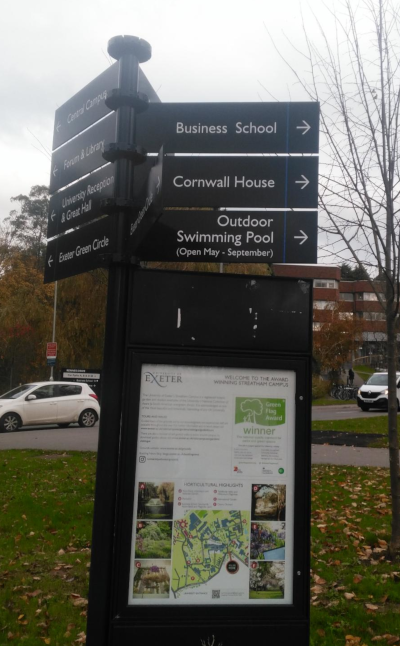
<p><img alt="An outdoor swimming pool next to my office."  align="left"
class="zoom" style="margin-right:20px;min-width:200px;" width="40%"
src="/blog/images/exeter-pool.png"> Today, I am starting a “new life” as Full
Professor (Chair for Cybersecurity) and Head of Group Cybersecurity Group (in
creation) at the <a href="http://emps.exeter.ac.uk/computer-science/">Computer Science
Department</a> at the <a href="https://www.exeter.ac.uk">University of
Exeter</a> (and, yes, there is a outdoor swimming pool
next to my new office).</p>
<p>Personally, I plan to continue my research in both a deep understanding of
<em>theory and practice</em> and, thus, being able to bridge the gap between theory and
practice as well as between industry and academia. My team will continue to work
on all kinds of aspects of developing secure, reliable, and resilient software
(and hardware) systems.</p>
<p>On a wider perspective, the Cybersecurity Group will include several lecturer
positions (the first offer has already been made, and the next call for
applications will be out soon). The team will grow fast and support the already
excellent and world-leading computer science department in Exeter with their
security expertise in research and education.</p>
<p>Having worked for eight years in the global security team of SAP SE, I have a
strong understanding of industrial needs and strengths. I am looking forward not
only to collaborate with my new colleagues at the university, I am also looking
forward to all kinds of collaborations with local industry in Devon, Cornwall,
and elsewhere.</p>
<p>Let’s <a href="https://www.brucker.ch/">stay in touch</a> and I am looking forward to
collaborations opportunities with all of you – regardless if you are working in
industry or academia and regardless if we already worked together or not!</p>
</article>
]]></summary>
</entry>
<entry>
    <title>Open Position as Lecturer in Cybersecurity</title>
    <link href="https://logicalhacking.com//blog/2019/03/28/acadmic-positions-in-security/" />
    <id>https://logicalhacking.com//blog/2019/03/28/acadmic-positions-in-security/</id>
    <published>2019-03-28T00:00:00Z</published>
    <updated>2019-03-28T00:00:00Z</updated>
    <summary type="html"><![CDATA[<article>
  <header>
    <div class="meta">
      Posted on 
      <time datetime="2019-03-28" pubdate data-updated="true">28 March 2019</time>
       by  <a href="https://www.brucker.ch/">Achim D. Brucker</a>, 
      licensed under <a href="https://creativecommons.org/licenses/by-nd/4.0/">CC BY-ND 4.0</a>.
      <div class="tags"><a href="/blog/tags/uoe/index.html">uoe</a> | <a href="/blog/tags/staff%26positions/index.html">staff&amp;positions</a> | <a href="/blog/tags/security/index.html">security</a></div>
      <meta name="fediverse:creator" content="@adbrucker@fediscience.org">
    </div>
    <h1 class="entry-title">
      <a href="/blog/2019/03/28/acadmic-positions-in-security/">Open Position as Lecturer in Cybersecurity</a>
    </h1>
  </header>
  <p>Do you want to join a world-class computer science department and help us to
establishment of an information and computer security research group? Then now
is the right time to
<a href="https://jobs.exeter.ac.uk/hrpr_webrecruitment/wrd/run/ETREC107GF.open?VACANCY_ID=458120OCP0&amp;WVID=3817591jNg">apply</a>.</p>
<!-- MORE -->
<p>The <a href="http://emps.exeter.ac.uk/computer-science/">Department Of Computer Science</a>
of the <a href="https://www.exeter.ac.uk">University of Exeter</a> is currently hiring for
a new cybersecurity group. The new lecturer will join a growing department and
will contribute to a new research focus in cybersecurity.</p>
<p>This is a <em>unique</em> opportunity to join a new cybersecurity group as founding
member and to influence its future development.</p>
<p>Application in all areas of cybersecurity are welcome, and we are particularly
encouraging people working in the intersection of security and formal aspects
(e.g., formal methods, verification, type systems, programming languages, logic)
to apply. Please apply by 4th of April 2019!</p>
</article>
]]></summary>
</entry>
<entry>
    <title>Welcome, Sakine Yalman!</title>
    <link href="https://logicalhacking.com//blog/2019/02/04/welcome-sakine/" />
    <id>https://logicalhacking.com//blog/2019/02/04/welcome-sakine/</id>
    <published>2019-02-04T00:00:00Z</published>
    <updated>2019-02-04T00:00:00Z</updated>
    <summary type="html"><![CDATA[<article>
  <header>
    <div class="meta">
      Posted on 
      <time datetime="2019-02-04" pubdate data-updated="true"> 4 February 2019</time>
       by  <a href="https://www.brucker.ch/">Achim D. Brucker</a>, 
      licensed under <a href="https://creativecommons.org/licenses/by-nd/4.0/">CC BY-ND 4.0</a>.
      <div class="tags"><a href="/blog/tags/tuos/index.html">tuos</a> | <a href="/blog/tags/staff%26positions/index.html">staff&amp;positions</a> | <a href="/blog/tags/phdlife/index.html">phdlife</a></div>
      <meta name="fediverse:creator" content="@adbrucker@fediscience.org">
    </div>
    <h1 class="entry-title">
      <a href="/blog/2019/02/04/welcome-sakine/">Welcome, Sakine Yalman!</a>
    </h1>
  </header>
  <p>I am happy to announce that <a href="http://www.sheffield.ac.uk/dcs/people/researchstudents">Sakine
Yalman</a> will join the
Software Assurance &amp; Security Research Team as a PhD student.</p>
<!-- MORE -->
<p>Sakine got her MSc in Advanced Computer Science from The University of
Sheffield. In her MSc thesis, she developed a static analysis tool for smart
contracts for the Ethereum blockchain. In her PhD studies, she will focus on
security and privacy aspects of cloud and edge computing.</p>
</article>
]]></summary>
</entry>
<entry>
    <title>Several Open (Senior) Lecturer/Reader position in Security</title>
    <link href="https://logicalhacking.com//blog/2017/03/24/acadmic-positions-in-security/" />
    <id>https://logicalhacking.com//blog/2017/03/24/acadmic-positions-in-security/</id>
    <published>2017-03-24T00:00:00Z</published>
    <updated>2017-03-24T00:00:00Z</updated>
    <summary type="html"><![CDATA[<article>
  <header>
    <div class="meta">
      Posted on 
      <time datetime="2017-03-24" pubdate data-updated="true">24 March 2017</time>
       by  <a href="https://www.brucker.ch/">Achim D. Brucker</a>, 
      licensed under <a href="https://creativecommons.org/licenses/by-nd/4.0/">CC BY-ND 4.0</a>.
      <div class="tags"><a href="/blog/tags/tuos/index.html">tuos</a> | <a href="/blog/tags/staff%26positions/index.html">staff&amp;positions</a> | <a href="/blog/tags/security/index.html">security</a></div>
      <meta name="fediverse:creator" content="@adbrucker@fediscience.org">
    </div>
    <h1 class="entry-title">
      <a href="/blog/2017/03/24/acadmic-positions-in-security/">Several Open (Senior) Lecturer/Reader position in Security</a>
    </h1>
  </header>
  <p>Do you want to join a world-class computer science department and help us to
establishment of an information and computer security research group? Then now
is the right time to
<a href="http://www.sheffield.ac.uk/dcs/research/groups/security/vacancies">apply</a>. We
have three Lecturer/Senior Lecturer/Reader to fill.</p>
<!-- MORE -->
<p>The <a href="http://www.sheffield.ac.uk/dcs/">Department Of Computer Science</a> at <a href="http://www.sheffield.ac.uk">The
University of Sheffield</a> is currently hiring for a
new <a href="http://www.sheffield.ac.uk/dcs/research/groups/security">Security of Advanced Systems
Group</a>. For more
details, have a look at the detailed <a href="http://www.sheffield.ac.uk/polopoly_fs/1.688807!/file/computer-security.pdf">job
brochure</a>.</p>
<p>Application deadline is the 28th April 2017.</p>
</article>
]]></summary>
</entry>
<entry>
    <title>Appointing a Chair in Security</title>
    <link href="https://logicalhacking.com//blog/2016/06/24/chair-in-security/" />
    <id>https://logicalhacking.com//blog/2016/06/24/chair-in-security/</id>
    <published>2016-06-24T00:00:00Z</published>
    <updated>2016-06-24T00:00:00Z</updated>
    <summary type="html"><![CDATA[<article>
  <header>
    <div class="meta">
      Posted on 
      <time datetime="2016-06-24" pubdate data-updated="true">24 June 2016</time>
       by  <a href="https://www.brucker.ch/">Achim D. Brucker</a>, 
      licensed under <a href="https://creativecommons.org/licenses/by-nd/4.0/">CC BY-ND 4.0</a>.
      <div class="tags"><a href="/blog/tags/tuos/index.html">tuos</a> | <a href="/blog/tags/staff%26positions/index.html">staff&amp;positions</a> | <a href="/blog/tags/security/index.html">security</a></div>
      <meta name="fediverse:creator" content="@adbrucker@fediscience.org">
    </div>
    <h1 class="entry-title">
      <a href="/blog/2016/06/24/chair-in-security/">Appointing a Chair in Security</a>
    </h1>
  </header>
  <p>Do you want to join a world-class computer science department and lead
the establishment of a information and computer security research
group? Then now is the right time to
<a href="http://www.sheffield.ac.uk/dcs/research/groups/security/index">apply</a>.</p>
<!-- MORE -->
<p>The <a href="http://www.sheffield.ac.uk/dcs/">Department Of Computer Science</a>
at <a href="http://www.sheffield.ac.uk">The University of Sheffield</a> is hiring
a
<a href="http://www.sheffield.ac.uk/dcs/research/groups/security/index"><em>Chair in Computer and Information Security</em></a>. We
are looking for a re-owned personality in all aspects of information
security, cybersecurity, or computer security that is looking for new
challenges. Joining The University of Sheffield provides a unique
opportunity to build up a new group leveraging the existing expertise
that go far beyond the research excellence of the fifth-best computer
science department in the UK (according to REF 2014): collaboration
opportunities are ranging from manufacturing (IoT, Industry 4.0) to
social and political sciences.</p>
<p>Application deadline is the 27th July 2016.</p>
</article>
]]></summary>
</entry>
<entry>
    <title>Welcome, Michael Herzberg!</title>
    <link href="https://logicalhacking.com//blog/2016/02/08/welcome-michael/" />
    <id>https://logicalhacking.com//blog/2016/02/08/welcome-michael/</id>
    <published>2016-02-08T00:00:00Z</published>
    <updated>2016-02-08T00:00:00Z</updated>
    <summary type="html"><![CDATA[<article>
  <header>
    <div class="meta">
      Posted on 
      <time datetime="2016-02-08" pubdate data-updated="true"> 8 February 2016</time>
       by  <a href="https://www.brucker.ch/">Achim D. Brucker</a>, 
      licensed under <a href="https://creativecommons.org/licenses/by-nd/4.0/">CC BY-ND 4.0</a>.
      <div class="tags"><a href="/blog/tags/tuos/index.html">tuos</a> | <a href="/blog/tags/staff%26positions/index.html">staff&amp;positions</a> | <a href="/blog/tags/phdlife/index.html">phdlife</a></div>
      <meta name="fediverse:creator" content="@adbrucker@fediscience.org">
    </div>
    <h1 class="entry-title">
      <a href="/blog/2016/02/08/welcome-michael/">Welcome, Michael Herzberg!</a>
    </h1>
  </header>
  <p>I am happy to announce that
<a href="http://www.sheffield.ac.uk/dcs/people/researchstudents">Michael Herzberg</a>
will join the Software Assurance &amp; Security Research Team as a PhD student.</p>
<!-- More -->
<p>Michael studied computer science at the Karlsruhe Institute of
Technology (KIT) in Germany and finished his studies there with a
thesis on “Static Code Analysis for Securing Cordova Application.”
During his PhD studies, he will apply formal modeling and
verification techniques to (software) vulnerabilities.</p>
</article>
]]></summary>
</entry>

</feed>