<?xml version="1.0" encoding="utf-8"?>
<feed xmlns="http://www.w3.org/2005/Atom">
    <title>logicalhacking.com: Posts tagged research</title>
    <link href="https://logicalhacking.com/blog/tags/research/index.xml" rel="self" />
    <link href="https://logicalhacking.com" />
    <id>https://logicalhacking.com/blog/tags/research/index.xml</id>
    <author>
        <name>Achim D. Brucker</name>
        <email>adbrucker@0x5f.org</email>
    </author>
    <updated>2018-10-20T00:00:00Z</updated>
    <entry>
    <title>Formalising EFSM Transition Merging</title>
    <link href="https://logicalhacking.com//blog/2018/10/20/esfm-inference/" />
    <id>https://logicalhacking.com//blog/2018/10/20/esfm-inference/</id>
    <published>2018-10-20T00:00:00Z</published>
    <updated>2018-10-20T00:00:00Z</updated>
    <summary type="html"><![CDATA[<article>
  <header>
    <div class="meta">
      Posted on 
      <time datetime="2018-10-20" pubdate data-updated="true">20 October 2018</time>
       by  <a href="https://www.brucker.ch/">Achim D. Brucker</a>, 
      licensed under <a href="https://creativecommons.org/licenses/by-nd/4.0/">CC BY-ND 4.0</a>.
      <div class="tags"><a href="/blog/tags/research/index.html">research</a> | <a href="/blog/tags/modelinference/index.html">modelinference</a> | <a href="/blog/tags/statemachine/index.html">statemachine</a> | <a href="/blog/tags/efsm/index.html">efsm</a> | <a href="/blog/tags/isabelle/hol/index.html">isabelle/hol</a></div>
      <meta name="fediverse:creator" content="@adbrucker@fediscience.org">
    </div>
    <h1 class="entry-title">
      <a href="/blog/2018/10/20/esfm-inference/">Formalising EFSM Transition Merging</a>
    </h1>
  </header>
  <p>Quite often, we need to develop a detailed understanding how a system
works, without having access to its internal implementation. For
example, we might need to understand and old legacy system, which we
want to connect to our brand-new infrastructure, or we want to do a
security assessment of a third party system.</p>
<p>One approach to develop a better understanding of a “black-box” system
is to infer a model (e.g., in form of a Finite State Machine) from
system traces.</p>
<!-- MORE -->
<p>Consider, for example, the following traces:
<span class="math display">\[
\begin{align*}
        &amp;\mathit{select}(\mathit{coke}) \rightarrow \mathit{coin}(50)/[50] \rightarrow \mathit{coin}(50)/[100] \rightarrow \mathit{vend}()/[coke] \\
        &amp;\mathit{select}(\mathit{coke}) \rightarrow \mathit{coin}(100)/[100] \rightarrow \mathit{vend}()/[\mathit{coke}] \\
        &amp;\mathit{select}(\mathit{pepsi}) \rightarrow \mathit{coin}(50)/[50] \rightarrow \mathit{vend}() \rightarrow \mathit{coin}(50)/[100] \rightarrow \mathit{vend}()/[\mathit{pepsi}]
\end{align*}
\]</span>
These traces describe certain executions of a vending machine (where
<span class="math inline">\(\mathit{label}(\mathit{arguments})/[\mathit{outputs}]\)</span> represents an
event).</p>
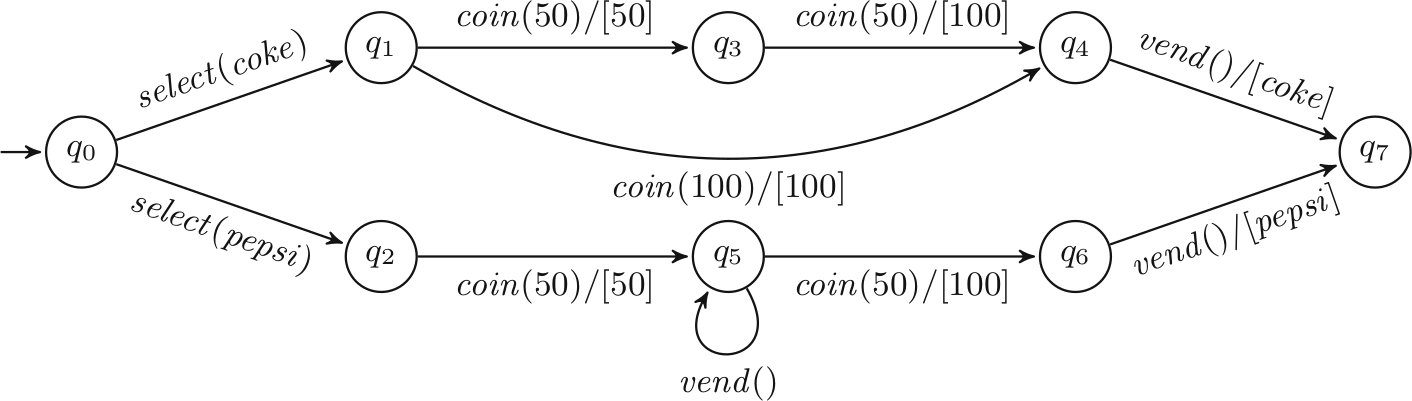
<p>Using Finite State Machine (FSM) inference, we can construct a FSM
that accepts the traces from out example:</p>
<p><img alt="An FSM accepting the traces from our example."
align="center" class="zoom" style="margin-right:20px;min-width:200px;" width="80%"
src="/blog/images/efsm-merging-example-fsm.png"></p>
<p>In traditional FSM inference, labels are atomic. For example,
<span class="math inline">\(\mathit{select}(\mathit{coke})\)</span> does not represent an event with label
<span class="math inline">\(\mathit{select}\)</span> and input <span class="math inline">\(\mathit{coke}\)</span>, rather the transition is labelled
by the literal string “select(coke)” making it a completely separate entity from
the transition “select(pepsi).” This is a major problem as it means that
information such as the selected drink and accrued funds must be encoded as part
of the control state. Increasing product choice or the coins accepted quickly
causes an explosion in model size disproportionate to the change in observable
behavior.</p>
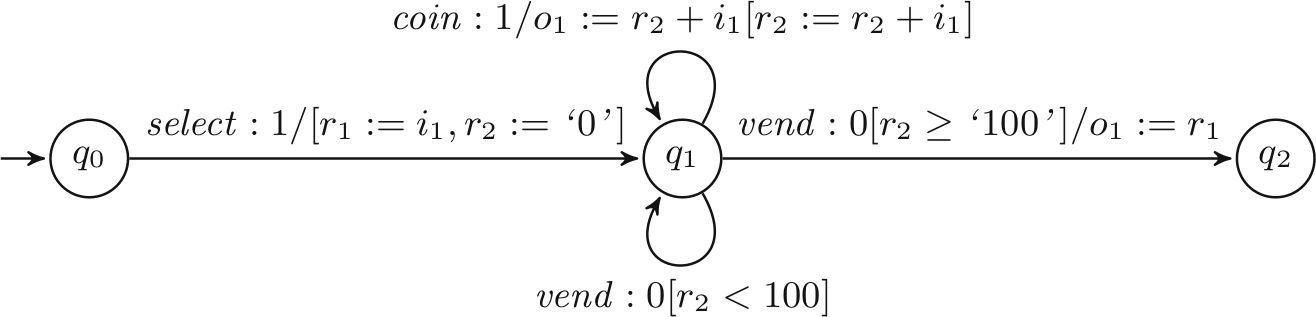
<p>EFSM inference can make use of a compact representation of the internal state of
the inferred system:</p>
<p><img alt="An EFSM accepting the traces from our example."
 class="zoom" style="margin-right:20px;min-width:200px;" width="80%"
src="/blog/images/efsm-merging-example-efsm.png"></p>
<p>In this EFSM, which also accepts the traces from our example, the selected drink
is stored in a register <span class="math inline">\(r_1\)</span> for later use in the output of the <span class="math inline">\(vend\)</span>
transition. A second register <span class="math inline">\(r_2\)</span> (initialized with <span class="math inline">\(0\)</span> by the select
transaction) keeps track of the money inserted so far. Drinks are only dispensed
once this value reaches <span class="math inline">\(100\)</span>. This enables customers to pay for their drink
with any coin in any order. This is a much more concise and faithful model of
the real system.</p>
<p>Current EFSM inference approaches tend to focus on guard expressions,
overlooking how individual transitions mutate the data state. The inference of
data update functions is a key technical challenge in EFSM inference but
significantly complicates the merging process.</p>
<p>In our ICFEM paper <span class="citation" data-cites="foster.ea:efsm:2018">[1]</span>, we present a novel approach for
inferring EFSMs from system traces that also infers the updates of the internal
state. Our approach supports the merging of transitions that update the internal
data state. Finally, our model is formalized in Isabelle/HOL, allowing for the
machine-checked verification of system properties.</p>
<p><strong>Update:</strong> The formalization is now available in the Archive of Formal Proofs:
“A Formal Model of Extended Finite State Machines” <span class="citation" data-cites="foster.ea:efsm:2020">[2]</span>.</p>
<h3 class="sectionAnchor unnumbered" id="references">References <a href="#references">§</a></h3>
<div id="refs" class="references csl-bib-body" role="doc-bibliography">
<div id="ref-foster.ea:efsm:2018" class="csl-entry" role="doc-biblioentry">
<div class="csl-left-margin">[1] </div><div class="csl-right-inline">M. Foster, R. G. Taylor, A. D. Brucker, and J. Derrick, <span>“Formalising extended finite state machine transition merging,”</span> in <em>ICFEM</em>, J. S. Dong and J. Sun, Eds. Heidelberg: Springer-Verlag, 2018, pp. 373–387. doi: <a href="https://doi.org/10.1007/978-3-030-02450-5">10.1007/978-3-030-02450-5</a>. Author copy: <a href="http://logicalhacking.com/publications/foster.ea-efsm-2018/" class="uri">http://logicalhacking.com/publications/foster.ea-efsm-2018/</a></div>
</div>
<div id="ref-foster.ea:efsm:2020" class="csl-entry" role="doc-biblioentry">
<div class="csl-left-margin">[2] </div><div class="csl-right-inline">M. Foster, A. D. Brucker, R. G. Taylor, and J. Derrick, <span>“A formal model of extended finite state machines,”</span> <em>Archive of Formal Proofs</em>, Sep. 2020. <a href="https://www.isa-afp.org/entries/Extended_Finite_State_Machines.html" class="uri">https://www.isa-afp.org/entries/Extended_Finite_State_Machines.html</a>, Formal proof development. Author copy: <a href="http://logicalhacking.com/publications/foster.ea-efsm-2020/" class="uri">http://logicalhacking.com/publications/foster.ea-efsm-2020/</a></div>
</div>
</div>
</article>
]]></summary>
</entry>
<entry>
    <title>Stateful Protocol Composition</title>
    <link href="https://logicalhacking.com//blog/2018/09/03/stateful-protocol-composition/" />
    <id>https://logicalhacking.com//blog/2018/09/03/stateful-protocol-composition/</id>
    <published>2018-09-03T00:00:00Z</published>
    <updated>2018-09-03T00:00:00Z</updated>
    <summary type="html"><![CDATA[<article>
  <header>
    <div class="meta">
      Posted on 
      <time datetime="2018-09-03" pubdate data-updated="true"> 3 September 2018</time>
       by  <a href="https://www.brucker.ch/">Achim D. Brucker</a>, 
      licensed under <a href="https://creativecommons.org/licenses/by-nd/4.0/">CC BY-ND 4.0</a>.
      <div class="tags"><a href="/blog/tags/research/index.html">research</a> | <a href="/blog/tags/security/index.html">security</a> | <a href="/blog/tags/isabelle/hol/index.html">isabelle/hol</a> | <a href="/blog/tags/composition/index.html">composition</a> | <a href="/blog/tags/protocols/index.html">protocols</a> | <a href="/blog/tags/logic/index.html">logic</a></div>
      <meta name="fediverse:creator" content="@adbrucker@fediscience.org">
    </div>
    <h1 class="entry-title">
      <a href="/blog/2018/09/03/stateful-protocol-composition/">Stateful Protocol Composition</a>
    </h1>
  </header>
  <p>Usually, networks such as the Internet run many security protocols (e.g., TLS,
IPSec, DNSSEC) in parallel. While the security properties of many of these
protocols have been analyzed in great detail, much less research has been
devoted to their parallel composition. It is far from self-evident that the
parallel composition of secure protocols is still secure, in fact one can
systematically construct counter-examples.</p>
<!-- MORE -->
<p>One such problem is if protocols have similar message structures of different
meaning, so that an attacker may be able to abuse messages, or parts thereof,
that he has learned in the context of one protocol, and use them in the context
of another where the same structure has a different meaning.</p>
<p>We address this problem in our ESORICS 2018 paper, entitled “Stateful Protocol
Composition” <span class="citation" data-cites="hess.ea:stateful:2018">[1]</span>. In particular, we extend the
compositionality paradigm to <em>stateful</em> protocols, where participants may
maintain a database (e.g., a list of valid public keys) independent of sessions.
Such databases do not necessarily grow monotonically during protocol execution:
we allow, for instance, negative membership checks and deletion of elements from
databases. Moreover, we allow for such databases to be <em>shared</em> between the
protocols to be composed. For instance, in the example of public keys, there
could be several protocols for registering, certifying, and revoking keys that
all work on the same public-key database. Since such a shared database can
potentially be exploited by the intruder to trigger harmful interferences, an
important part of our result is a clear coordination of the ways in which each
protocol is allowed to access the database. This coordination is based on
assumptions and guarantees on the transactions that involve the database.
Moreover, this also allows us to support protocols with the declassification of
long-term secrets (e.g., that the private key to a revoked public key may be
learned by the intruder without breaking the security goals). The result is so
general that it actually also covers many forms of <em>sequential composition</em>
as a special case, since one can for instance model that one protocol inserts
keys into a database of fresh session keys, and another protocol “consumes” and
uses them.</p>
<p>The proof of the main result is by a reduction to a problem finding solutions
for intruder constraints: given a satisfiable constraint representing an attack
on the composition, we show that the projection of the constraints to the
individual protocols are satisfiable. This particular tricky part of the <a href="https://people.compute.dtu.dk/samo/composec.html">proof
has been formalized</a> in the
interactive theorem prover Isabelle/HOL.</p>
<p>For details, read our ESORICS paper <span class="citation" data-cites="hess.ea:stateful:2018">[1]</span> or the
extended version <span class="citation" data-cites="hess.ea:tr-stateful-protocol:2018">[2]</span>, which includes
the pen-and-paper proofs and short explanations of the Isabelle
proofs.</p>
<p><strong>Update:</strong> The formalization is now available in the Archive of Formal Proofs:
“Stateful Protocol Composition and Typing” <span class="citation" data-cites="hess.ea:stateful:2020">[3]</span>.</p>
<h3 class="sectionAnchor unnumbered" id="references">References <a href="#references">§</a></h3>
<div id="refs" class="references csl-bib-body" role="doc-bibliography">
<div id="ref-hess.ea:stateful:2018" class="csl-entry" role="doc-biblioentry">
<div class="csl-left-margin">[1] </div><div class="csl-right-inline">A. V. Hess, S. A. Mödersheim, and A. D. Brucker, <span>“Stateful protocol composition,”</span> in <em>ESORICS</em>, J. Lopez and J. Zhou, Eds. Heidelberg: Springer-Verlag, 2018, pp. 427–446. doi: <a href="https://doi.org/10.1007/978-3-319-99073-6">10.1007/978-3-319-99073-6</a>. Author copy: <a href="http://logicalhacking.com/publications/hess.ea-stateful-2018/" class="uri">http://logicalhacking.com/publications/hess.ea-stateful-2018/</a></div>
</div>
<div id="ref-hess.ea:tr-stateful-protocol:2018" class="csl-entry" role="doc-biblioentry">
<div class="csl-left-margin">[2] </div><div class="csl-right-inline">A. V. Hess, S. A. Mödersheim, and A. D. Brucker, <span>“Stateful protocol composition (extended version),”</span> DTU Compute, Technical University Denmark, 2018-03, 2018. Author copy: <a href="http://logicalhacking.com/publications/hess.ea-tr-stateful-protocol-2018/" class="uri">http://logicalhacking.com/publications/hess.ea-tr-stateful-protocol-2018/</a></div>
</div>
<div id="ref-hess.ea:stateful:2020" class="csl-entry" role="doc-biblioentry">
<div class="csl-left-margin">[3] </div><div class="csl-right-inline">A. V. Hess, S. Mödersheim, and A. D. Brucker, <span>“Stateful protocol composition and typing,”</span> <em>Archive of Formal Proofs</em>, Apr. 2020. <a href="https://www.isa-afp.org/entries/Stateful_Protocol_Composition_and_Typing.html" class="uri">https://www.isa-afp.org/entries/Stateful_Protocol_Composition_and_Typing.html</a>, Formal proof development. Author copy: <a href="http://logicalhacking.com/publications/hess.ea-stateful-2020/" class="uri">http://logicalhacking.com/publications/hess.ea-stateful-2020/</a></div>
</div>
</div>
</article>
]]></summary>
</entry>
<entry>
    <title>HOL-TestGen 1.9.1 Released</title>
    <link href="https://logicalhacking.com//blog/2017/08/31/hol-testgen-1.9.1/" />
    <id>https://logicalhacking.com//blog/2017/08/31/hol-testgen-1.9.1/</id>
    <published>2017-08-31T00:00:00Z</published>
    <updated>2017-08-31T00:00:00Z</updated>
    <summary type="html"><![CDATA[<article>
  <header>
    <div class="meta">
      Posted on 
      <time datetime="2017-08-31" pubdate data-updated="true">31 August 2017</time>
       by  <a href="https://www.brucker.ch/">Achim D. Brucker</a>, 
      licensed under <a href="https://creativecommons.org/licenses/by-nd/4.0/">CC BY-ND 4.0</a>.
      <div class="tags"><a href="/blog/tags/research/index.html">research</a> | <a href="/blog/tags/testing/index.html">testing</a> | <a href="/blog/tags/hol-testgen/index.html">hol-testgen</a> | <a href="/blog/tags/isabelle/hol/index.html">isabelle/hol</a> | <a href="/blog/tags/test%26proof/index.html">test&amp;proof</a> | <a href="/blog/tags/tools/index.html">tools</a> | <a href="/blog/tags/logic/index.html">logic</a></div>
      <meta name="fediverse:creator" content="@adbrucker@fediscience.org">
    </div>
    <h1 class="entry-title">
      <a href="/blog/2017/08/31/hol-testgen-1.9.1/">HOL-TestGen 1.9.1 Released</a>
    </h1>
  </header>
  <p>We are proud to announce the release of <a href="https://www.brucker.ch/projects/hol-testgen/">HOL-TestGen
1.9.1</a> HOL-TestGen is a formal
specification-based test environment HOL-TestGen that allows to have a seamless
transition from verification to test case generation using symbolic computation
in Isabelle/HOL.</p>
<!-- MORE -->
<p>This release is a maintenance release based on the most recent version of
Isabelle/HOL, i.e., <a href="http://isabelle.in.tum.de/website-Isabelle2016-1/index.html">Isabelle
2016-1</a>.</p>
<h2 class="sectionAnchor" id="supplementary-material">Supplementary Material <a href="#supplementary-material">§</a></h2>
<ul>
<li>HOL-TestGen Website: <a href="https://www.brucker.ch/projects/hol-testgen/" class="uri">https://www.brucker.ch/projects/hol-testgen/</a></li>
</ul>
</article>
]]></summary>
</entry>
<entry>
    <title>HOL-TestGen 1.9 Released</title>
    <link href="https://logicalhacking.com//blog/2017/07/19/hol-testgen-1.9/" />
    <id>https://logicalhacking.com//blog/2017/07/19/hol-testgen-1.9/</id>
    <published>2017-07-19T00:00:00Z</published>
    <updated>2017-07-19T00:00:00Z</updated>
    <summary type="html"><![CDATA[<article>
  <header>
    <div class="meta">
      Posted on 
      <time datetime="2017-07-19" pubdate data-updated="true">19 July 2017</time>
       by  <a href="https://www.brucker.ch/">Achim D. Brucker</a>, 
      licensed under <a href="https://creativecommons.org/licenses/by-nd/4.0/">CC BY-ND 4.0</a>.
      <div class="tags"><a href="/blog/tags/research/index.html">research</a> | <a href="/blog/tags/testing/index.html">testing</a> | <a href="/blog/tags/hol-testgen/index.html">hol-testgen</a> | <a href="/blog/tags/isabelle/hol/index.html">isabelle/hol</a> | <a href="/blog/tags/test%26proof/index.html">test&amp;proof</a> | <a href="/blog/tags/tools/index.html">tools</a> | <a href="/blog/tags/logic/index.html">logic</a></div>
      <meta name="fediverse:creator" content="@adbrucker@fediscience.org">
    </div>
    <h1 class="entry-title">
      <a href="/blog/2017/07/19/hol-testgen-1.9/">HOL-TestGen 1.9 Released</a>
    </h1>
  </header>
  <p>We are proud to announce the release of <a href="https://www.brucker.ch/projects/hol-testgen/">HOL-TestGen
1.9.</a> HOL-TestGen is a formal
specification-based test environment HOL-TestGen that allows to have a seamless
transition from verification to test case generation using symbolic computation
in Isabelle/HOL.</p>
<!-- MORE -->
<p>This release is a maintenance release based on <a href="http://isabelle.in.tum.de/website-Isabelle2016/index.html">Isabelle
2016</a>.</p>
<h3 class="sectionAnchor" id="supplementary-material">Supplementary Material <a href="#supplementary-material">§</a></h3>
<ul>
<li>HOL-TestGen Website: <a href="https://www.brucker.ch/projects/hol-testgen/" class="uri">https://www.brucker.ch/projects/hol-testgen/</a></li>
</ul>
</article>
]]></summary>
</entry>
<entry>
    <title>HOL-TestGen 1.8 Released</title>
    <link href="https://logicalhacking.com//blog/2016/04/23/hol-testgen-1.8/" />
    <id>https://logicalhacking.com//blog/2016/04/23/hol-testgen-1.8/</id>
    <published>2016-04-23T00:00:00Z</published>
    <updated>2016-04-23T00:00:00Z</updated>
    <summary type="html"><![CDATA[<article>
  <header>
    <div class="meta">
      Posted on 
      <time datetime="2016-04-23" pubdate data-updated="true">23 April 2016</time>
       by  <a href="https://www.brucker.ch/">Achim D. Brucker</a>, 
      licensed under <a href="https://creativecommons.org/licenses/by-nd/4.0/">CC BY-ND 4.0</a>.
      <div class="tags"><a href="/blog/tags/research/index.html">research</a> | <a href="/blog/tags/testing/index.html">testing</a> | <a href="/blog/tags/hol-testgen/index.html">hol-testgen</a> | <a href="/blog/tags/isabelle/hol/index.html">isabelle/hol</a> | <a href="/blog/tags/test%26proof/index.html">test&amp;proof</a> | <a href="/blog/tags/tools/index.html">tools</a> | <a href="/blog/tags/logic/index.html">logic</a></div>
      <meta name="fediverse:creator" content="@adbrucker@fediscience.org">
    </div>
    <h1 class="entry-title">
      <a href="/blog/2016/04/23/hol-testgen-1.8/">HOL-TestGen 1.8 Released</a>
    </h1>
  </header>
  <p>We are proud to announce the release of
<a href="https://www.brucker.ch/projects/hol-testgen/">HOL-TestGen 1.8.</a>
HOL-TestGen is a formal specification-based test environment
HOL-TestGen that allows to have a seamless transition from
verification to test case generation using symbolic computation in
Isabelle/HOL.</p>
<!-- MORE -->
<p>On the one hand, this release is a maintenance release based on
<a href="http://isabelle.in.tum.de/website-Isabelle2013-2/index.html">Isabelle 2013-2</a>. On
the other hand, it marks an important milestone on our way to support
a more recent version of Isabelle, i.e., Isabelle 2016. Thus, the next
release will be based on Isabelle 2016 (or later).</p>
<h3 class="sectionAnchor" id="supplementary-material">Supplementary Material <a href="#supplementary-material">§</a></h3>
<ul>
<li>HOL-TestGen Website: <a href="https://www.brucker.ch/projects/hol-testgen/" class="uri">https://www.brucker.ch/projects/hol-testgen/</a></li>
<li><a href="https://www.brucker.ch/bibliography/download/2016/brucker.ea-hol-testgen-2016.pdf">HOL-TestGen 1.8 User Guide</a></li>
</ul>
</article>
]]></summary>
</entry>
<entry>
    <title>Formal Firewall Conformance Testing</title>
    <link href="https://logicalhacking.com//blog/2015/12/15/testing-firewalls/" />
    <id>https://logicalhacking.com//blog/2015/12/15/testing-firewalls/</id>
    <published>2015-12-15T00:00:00Z</published>
    <updated>2015-12-15T00:00:00Z</updated>
    <summary type="html"><![CDATA[<article>
  <header>
    <div class="meta">
      Posted on 
      <time datetime="2015-12-15" pubdate data-updated="true">15 December 2015</time>
       by  <a href="https://www.brucker.ch/">Achim D. Brucker</a>, 
      licensed under <a href="https://creativecommons.org/licenses/by-nd/4.0/">CC BY-ND 4.0</a>.
      <div class="tags"><a href="/blog/tags/research/index.html">research</a> | <a href="/blog/tags/securitytesting/index.html">securitytesting</a> | <a href="/blog/tags/security/index.html">security</a> | <a href="/blog/tags/hol-testgen/index.html">hol-testgen</a> | <a href="/blog/tags/isabelle/hol/index.html">isabelle/hol</a> | <a href="/blog/tags/test%26proof/index.html">test&amp;proof</a></div>
      <meta name="fediverse:creator" content="@adbrucker@fediscience.org">
    </div>
    <h1 class="entry-title">
      <a href="/blog/2015/12/15/testing-firewalls/">Formal Firewall Conformance Testing</a>
    </h1>
  </header>
  <p>If you ever tried to enforce a network policy in a large data center,
i.e., needed to configure the different firewalls and routers, you
will agree that this is a tedious and error-prone task. This is even
more true, if you need to maintain and change those policies over a
long period of time. Understanding, the actual policy
enforced in a non-trivial network setup (e.g., a data center with
multiple fall-back connections) is even harder.</p>
<p>One way of ensuring that important security (access control)
properties of a network are true and are not changed during
reconfiguration is testing. We developed a specification-based
(model-based) testing approach for network policies that allows to
represent network policies in a high-level language, to optimize the
policies, and to generate test cases that can directly be executed in
a real-world network.</p>
<!-- MORE -->
<p>Our approach supports complex policies that require network
translation (NAT) or port forwarding as well as stateful and
stateless protocols (thus, we capture the concept of widely used
network filters such as iptables). For the following example,
let’s limit ourselves to simple packet filters and a very simple
network policy that is illustrated by the following table:</p>
<table>
<thead>
<tr class="header">
<th>source</th>
<th>destination</th>
<th>protocol</th>
<th>port</th>
<th>action</th>
</tr>
</thead>
<tbody>
<tr class="odd">
<td>internet</td>
<td>dmz</td>
<td>udp</td>
<td>25</td>
<td>allow</td>
</tr>
<tr class="even">
<td>internet</td>
<td>dmz</td>
<td>tcp</td>
<td>80</td>
<td>allow</td>
</tr>
<tr class="odd">
<td>dmz</td>
<td>intranet</td>
<td>tcp</td>
<td>25</td>
<td>allow</td>
</tr>
<tr class="even">
<td>intranet</td>
<td>dmz</td>
<td>tcp</td>
<td>993</td>
<td>allow</td>
</tr>
<tr class="odd">
<td>intranet</td>
<td>internet</td>
<td>udp</td>
<td>80</td>
<td>allow</td>
</tr>
<tr class="even">
<td>any</td>
<td>any</td>
<td>any</td>
<td>any</td>
<td>deny</td>
</tr>
</tbody>
</table>
<p>In our example, we have three sub-nets (internet, intranet, and dmz)
and the intranet (i.e., the internal network) should be protected from
the outside network (i.e., the internet). This representation is
rather similar to the usual textbook representation of network
policies. In our formalism (or DSL), we can express this policy as
follows:
<span class="math display">\[
\newcommand{\cmd}[1]{\operatorname{\color{blue}{#1}}}
\newcommand{\fw}[1]{\operatorname{#1}}
\begin{align}
\cmd{definition}~\mathrm{TestPolicy} \cmd{where}\\
 TestPolicy   &amp;=      \fw{allow\_port} \fw{udp}  25 \fw{internet} \fw{dmz}      \\
              &amp;\oplus \fw{allow\_port} \fw{tcp}  80 \fw{internet} \fw{dmz}      \\
              &amp;\oplus \fw{allow\_port} \fw{tcp}  25 \fw{dmz}      \fw{intranet} \\
              &amp;\oplus \fw{allow\_port} \fw{tcp} 993 \fw{intranet} \fw{dmz}      \\
              &amp;\oplus \fw{allow\_port} \fw{udp}  80 \fw{intranet} \fw{internet} \\
              &amp;\oplus D_U
\end{align}
\]</span>
where <span class="math inline">\(D_U\)</span> is the policy that denies all traffic.</p>
<p>Using this policy definition, we can state our <em>test specification</em> as
follows:
<span class="math display">\[
\begin{align}
\cmd{test\_spec} \fw{test:}~~ &amp; P~x \Longrightarrow FUT~x = \mathrm{TestPolicy}~x
\end{align}
\]</span>
In general, this specifies that the firewall implementation under test
(<span class="math inline">\(FUT\)</span>) should behave for all packages satisfying the predicate <span class="math inline">\(P\)</span>
should behave as the specification. Thus, the <span class="math inline">\(P\)</span> allows us to specify additional test
constraints such as to not to generated test cases that test traffic
within one sub-net (which, most likely, cannot be monitored easily).</p>
<p>Using our automated test case generation approach that is implemented
on top of <a href="https://www.brucker.ch/projects/hol-testgen/">HOL-TestGen</a>
we obtain test cases that both check that packages that should be
accepted (i.e., pass through the network) are actually accepted and
that all others are denied. A (simplified) test case for a denied
package looks as follows:
<span class="math display">\[
FUT(1,((8,13,12,10),6,\fw{tcp}),((172,168,2,1),80,\fw{tcp}),data)= \lfloor(\fw{deny}()\rfloor
\]</span></p>
<p>This approach is described in all details in our journal paper
<span class="citation" data-cites="brucker.ea:formal-fw-testing:2014">[1]</span> in detail in our
<a href="http://www.brucker.ch/bibliography/abstract/brucker.ea-formal-fw-testing-2014">journal paper</a>
and the implementation is available as part of the
<a href="https://www.brucker.ch/projects/hol-testgen/">HOL-TestGen distribution</a>. Our
approach has inspired the colleagues at Microsoft Research to a
similar approach using Z3 that is now used for testing the
configuration of the Azure data centers.</p>
<p><span class="Z3988" title="ctx_ver=Z39.88-2004&amp;rft_val_fmt=info%3Aofi%2Ffmt%3Akev%3Amtx%3Ajournal&amp;rft.jtitle=Software+Testing%2C+Verification+and+Reliability&amp;rft_id=info%3Adoi%2F10.1002%2Fstvr.1544&amp;rfr_id=info%3Asid%2Fresearchblogging.org&amp;rft.atitle=Formal+firewall+conformance+testing%3A+an+application+of+test+and+proof+techniques&amp;rft.issn=09600833&amp;rft.date=2015&amp;rft.volume=25&amp;rft.issue=1&amp;rft.spage=34&amp;rft.epage=71&amp;rft.artnum=http%3A%2F%2Fdoi.wiley.com%2F10.1002%2Fstvr.1544&amp;rft.au=Brucker%2C+A.D.&amp;rft.au=Br%C3%BCgger%2C+L.&amp;rft.au=Wolff%2C+B.&amp;rfe_dat=bpr3.included=1;bpr3.tags=Computer+Science+%2F+Engineering%2CSecurity%2C+Logic%2C+Testing%2C+Verification%2C+Software+Engineering%2C+Theorem+Proving%2C+Formal+Methods">
Brucker, A.D., Brügger, L., &amp; Wolff, B. (2015). Formal firewall conformance testing: an application of test and proof techniques
<span style="font-style: italic;">Software Testing, Verification and Reliability, 25</span> (1), 34-71 DOI:
<a rev="review" href="http://dx.doi.org/10.1002/stvr.1544">10.1002/stvr.1544</a>
</span></p>
<h3 class="sectionAnchor unnumbered" id="references">References <a href="#references">§</a></h3>
<div id="refs" class="references csl-bib-body" role="doc-bibliography">
<div id="ref-brucker.ea:formal-fw-testing:2014" class="csl-entry" role="doc-biblioentry">
<div class="csl-left-margin">[1] </div><div class="csl-right-inline">A. D. Brucker, L. Brügger, and B. Wolff, <span>“Formal firewall conformance testing: An application of test and proof techniques,”</span> <em>Software Testing, Verification &amp; Reliability (STVR)</em>, vol. 25, no. 1, pp. 34–71, 2015, doi: <a href="https://doi.org/10.1002/stvr.1544">10.1002/stvr.1544</a>. Author copy: <a href="http://logicalhacking.com/publications/brucker.ea-formal-fw-testing-2014/" class="uri">http://logicalhacking.com/publications/brucker.ea-formal-fw-testing-2014/</a></div>
</div>
</div>
</article>
]]></summary>
</entry>

</feed>